When Stephen and I traveled to Bhutan, I had two hopes.
The first was to receive a reading from a lama. I wanted to sit with someone who could look at my life through a different system of understanding — astrology, intuition, spirit, whatever language belongs to that kind of exchange. I was open to it.
The second hope was less specific, but in some ways more powerful. I wanted to find an object. Not a souvenir or something I could have bought anywhere. I wanted to discover something that felt as though it already knew me. Something that wanted to come home with me. Something that carried a little mystery, a little memory, maybe even some sense of a past life.
I have always felt deeply drawn to Asian cultures. There is something about the beauty, ritual, symbolism, and calm that speaks to me in a very personal way. So before we even arrived in Bhutan, I had this idea in my mind: somewhere along the journey, there would be an object I was meant to find.
And then— there it was.
The Object That Spun
Stephen and I were staying at the Aman properties in Bhutan, where they have five lodges in different parts of the country, each connected and built indigenous to the landscape and spirit of the place. At Amankora Thimphu there was a small shop with local antiquities and objects. This is where I saw the prayer wheel. It was absolutely magical.
The form itself was beautiful — a cylinder, meant to spin with writing across it, inlaid color, turquoise, coral, brass and an extraordinary sense of presence. It was elegant and ancient-feeling, but also alive. It didn’t just sit there. It invited touch. I placed my finger on one of the tabs and spun it.
In that moment, I couldn’t help wondering who had used it before. Whose hand had turned it. What prayers had been sent into motion. What worries had been soothed. What questions had been carried by its spinning. What kind of calm it had offered to someone who needed it.
It felt like a wheel of mystery and memory that held secrets and returned peace.
I looked at it and thought: I know you. Or perhaps: I knew you. Either way, I had to bring it home.
A Jewel with a Soul
There are some objects you admire, and then there are objects you recognize. This was recognition.
The prayer wheel was exquisite, almost like a jewel with so many facets — color, texture, movement, history, spirit. It seemed to hold more than itself, to have a soul.
Not every object does. Many beautiful things are simply beautiful. But once in a while, something carries a deeper feeling that has been touched by time, by use, by devotion, by the lives of people you will never know. You cannot prove that.
I felt it with the prayer wheel. I felt that it had soothed someone before me. I felt that it had once belonged to a rhythm of faith or meditation or daily practice. I felt that its beauty was beyond decorative and needed to be honored.
Giving It Prominence
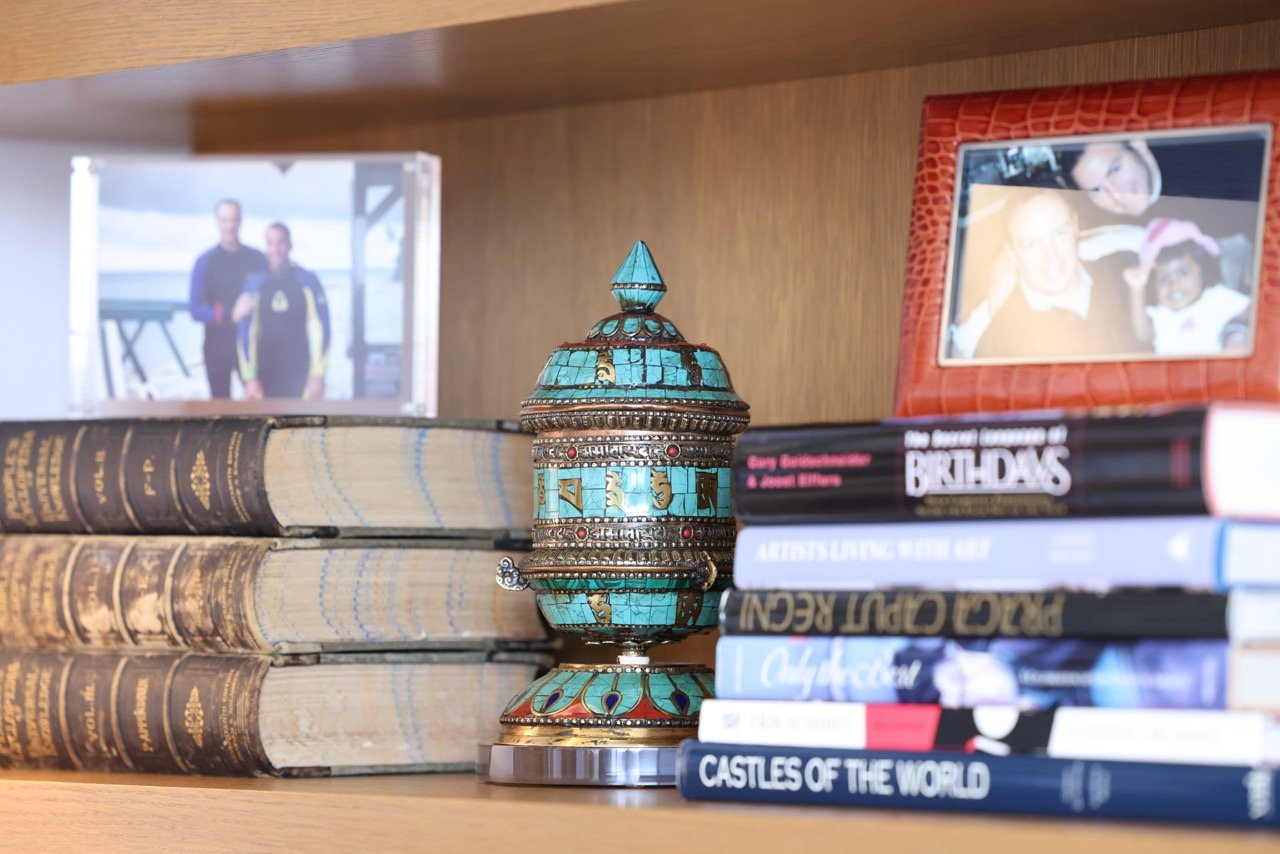
When I brought the prayer wheel home, I had a lucite mount made for it, because I didn’t want it lying down or disappearing among other objects. I wanted it elevated, to have air and light around it. I wanted it to stand with the kind of prominence I felt it deserved.
Now it sits on a shelf surrounded by books that have been arranged to serve it. Rather than standing vertically, they are laid horizontally. On one side are old dictionaries. On the other side is a selection of more current volumes. But neither side rises above the prayer wheel. I kept the stacks low so that the wheel’s crown can sit higher. Situating the prayer wheel with books nearby connects it to language, thought, belief, and history. The old dictionaries carry the past in their own way, and the contemporary books tell us that the present matters, too.
Growing up in Washington, D.C., I always knew the idea that no building should rise higher than the Washington Monument. Whether perfectly literal or not, the spirit of that idea stayed with me: some things need to remain the visual center. Some things deserve the sky above them. This is how I feel about the prayer wheel. The books are its neighborhood, but the prayer wheel is the monument.
What Comes Home With Us
Travel changes us when we allow something to come home in the right way. Not the souvenir version of travel, where objects are collected only to prove we have been somewhere. I mean the deeper kind, when something we find in another place becomes part of how we live in our own.
The prayer wheel brought Bhutan home with me. It brought back the feeling of the country, the calm, the devotion, the beauty of a place where happiness is considered a measure of national life. It brought back the landscape, the rituals, the sense of quiet reverence I felt there. And it brought back a question I still carry: what do we choose to elevate?
In a home, that question matters. We elevate certain objects because they are expensive, or rare, or impressive. But we also elevate things because they hold meaning. They remind us of who we were in a particular place and connect us to something larger than ourselves.
Every time I see the prayer wheel, I remember the moment it spun beneath my finger, recalling the feeling that it had known me somehow. its embedded feelings of peace remind me daily that the differences among cultures are a celebration to our greater similarity: the beautiful connection of humanity, the grace of love, and the gift of peace we give back to each other. So,
Love to live Happily Ever Always™.