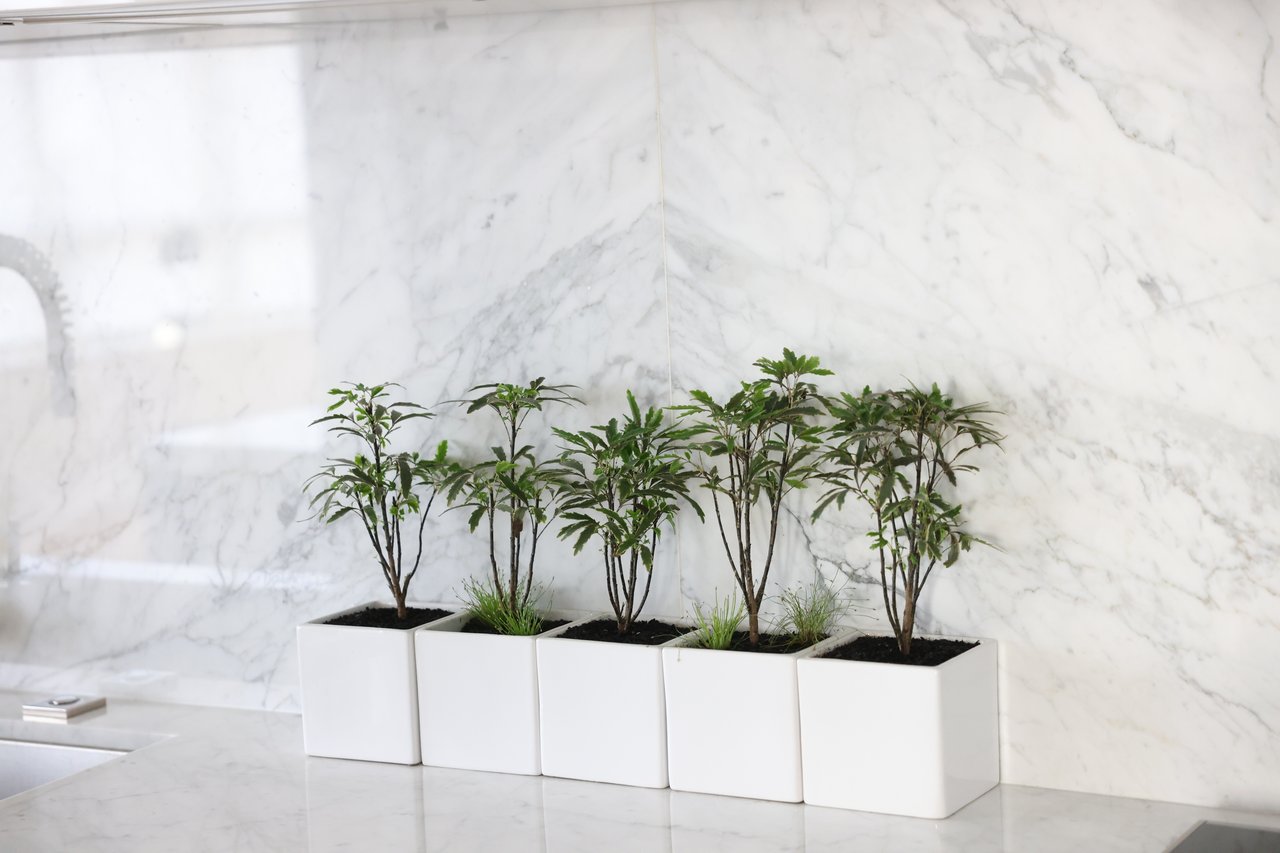
There are five bonsai trees on my kitchen counter. They are small, sculptural, and alive in the way only miniature trees can — quiet, contained, almost ancient in their presence. But they aren’t there simply because I like bonsai, though I do. They are there because of the marble behind them. Or more precisely, because of what I saw in the marble.
When Stephen and I were creating this home, every choice carried weight. The rooms weren’t being assembled so much as listened to. We worked with our architect, Elissa Scrafano, and our designer, Doug Levine, to shape a home that felt refined, personal, and deeply considered. And at one point in the process, we needed 18 slabs of stone.
I knew I wanted statuary marble — that milky white marble with gray veining, the kind so many classical sculptures in Europe were carved from. I didn’t want Carrara or Calcutta Gold. I wanted something quieter, softer, more luminous. Something with presence, but not performance. After looking at several options, we found the marble through a circumstance that felt almost meant to be. A home in Lake Forest had purchased a lot of 19 slabs, but one of them had broken. Because they needed all 19, they could no longer use the group. We needed 18.
So the marble came to us. Before I let anyone cut a single piece, I studied the slabs carefully. I chose which pieces belonged in which rooms. Stone has a voice, and if you are going to live with it every day, you have to listen before you ask anyone to reshape it.
Then I saw it. In the book-matched marble backsplash behind the kitchen counter, the veining opened into the faint outline of a mountain. It was not literal, exactly. It was more like a suggestion — a soft landscape appearing in gray and white, as if the stone had been carrying it quietly for centuries and was waiting for someone to notice.
The moment I saw it, I thought of Vermont. I thought of Mount Equinox. I thought of Stowe. I thought of driving through that green mountain state, moving past picturesque mountains, memorable trees and long stretches of natural quiet. There is something about Vermont that has always stayed with me — not just the scenery, but the feeling of it. The deep green. The calm. The sense that nature has arranged itself with an elegance no decorator could improve upon. Standing there, looking at that marble, I could suddenly see the whole thing. If the marble was the mountain, then the counter needed trees. So I brought in the bonsai.
That is how those small trees came to live in the kitchen. They are not decoration in the usual sense. They are part of the landscape. They complete something that was already there. They reinterpret the living that brings sparkle into our lives.
I think the best homes often work that way. You do not always invent the story. Sometimes you discover it. A room gives you a clue. A material reveals an image. A surface holds a memory you did not expect to find. And if you are paying attention, the right response becomes obvious.
For me, these bonsai trees are a response. They answer the marble. They bring Vermont into the room without making any announcement about it. They turn a kitchen surface into a horizon line. They make the memory visible, but softly, which is how I think memory often prefers to live.
I have always loved the idea that the past does not have to stay behind us. It can be remade, reinterpreted, and carried forward into the present. Not as nostalgia. Not as a shrine. But as atmosphere and instinct. As the feeling a room gives you before you can quite explain why.The trees on the counter are exactly that for me. They are a memory of Vermont living inside a Chicago kitchen. They are the mountains of Stowe translated through stone and scale. They are the result of seeing something, trusting it, and letting the home tell me what it wanted next.
A home is not made beautiful by filling it with beautiful things. A home becomes beautiful when the things inside it begin to speak to one another. When the marble remembers a mountain. When the trees answer back. When the past finds a way to live quietly in the present.
Because when memory, beauty, and attention come together in just the right way, the room gives something back.
Happily Ever Always.™