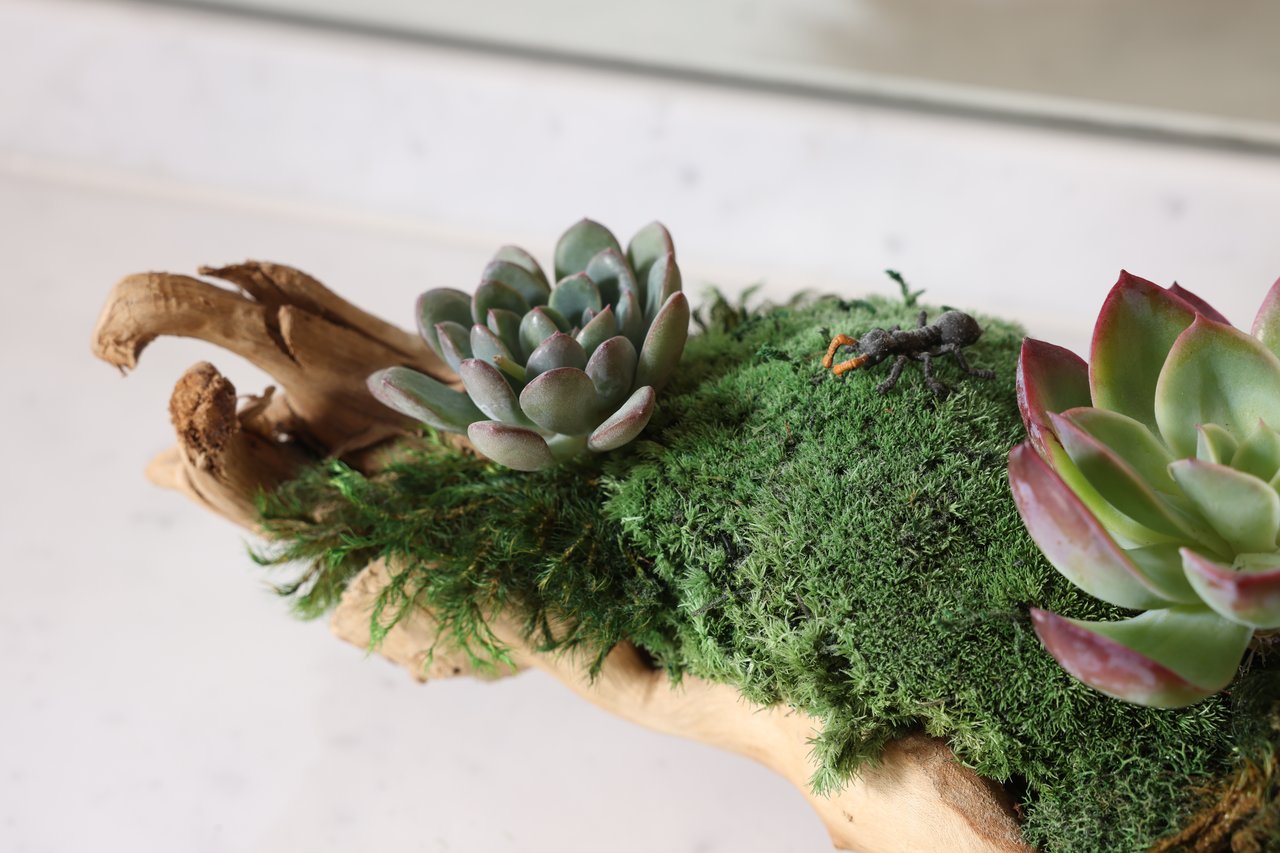
There is a small black ant living in my home.
Not a real ant, though I suppose that depends on how generous you want to be with the word real. She is made of rubber. She came from a children’s toy store in Wicker Park. She is all black, with just the slightest bit of yellow at the front and from the moment I saw her, I thought: You need to come home.
That may sound odd, but I have always believed that things ask to come home with us. Not every thing, of course. Most things are just things. But once in a while, you see an object and it speaks in a language that bypasses logic entirely. It does not ask whether you need it. It asks whether you recognize it.
I recognized Ant. She was marvelous to me: her little legs, her body shape, her strange dignity. She looked like something that had wandered out of a fable and was waiting for the right person to notice her.
I didn’t mean my home exactly. I meant a home within my home. That is where she lives now — inside a glass terrarium, protected and loved, surrounded by succulents and cacti and a tiny world that feels, at least to me, perfectly suited to her. She has no practical purpose. She does not hold keys, serve drinks, light a room, or perform any of the small assignments we tend to give the objects in our lives. She is simply there. And because she is there, the whole little world around her feels more alive. I suppose that is why I brought her home in the first place.
The Homes I Made as a Child
If I think about it honestly, Ant’s story really begins much earlier. When I was a child, I loved animals. My parents let me bring almost everything into the house except snakes. I had turtles, frogs, lizards, goldfish, tropical fish, gerbils — all kinds of small creatures that required little worlds of their own. And I loved making those worlds.
I didn’t just put an animal in a tank and call it done. I wanted the environment to feel special. I wanted the lizards to have beautiful little plants to crawl over and climb down from. I wanted the frogs and turtles and fish to have places that felt considered. If I had been that animal, I would have wanted to live there. Looking back, I think that was one of my earliest forms of design.
I was not using words like atmosphere or scale or composition. I was not thinking about interiors. I was simply arranging a place with care. I wanted each little habitat to feel alive, protected, and complete. And when one of those animals died, I would place it in a box, bury it in the yard, and hold a funeral. My parents and sister had to come. My father had to say a few words. It mattered to me that these creatures had been here, and that their lives deserved ceremony.
That instinct has never really left me.
A Home Within a Home
I do not have animals now. Stephen and I travel too much. It is the only reason we do not have a dog, though we would love one desperately. I recently mentioned to him that what I really want is a little black goat named Roger, which probably means we need a farm in Galena at some point.
But until Roger arrives, there is Ant. Ant lets me have a little piece of that childhood world again — not literally, but emotionally. She brings back the feeling of making a habitat, of creating a place for something small and vulnerable, even if that something is imagined. She reminds me that design can be about tenderness, and making a home for a creature no one else would think to house.
That may be the thing I love most about her. She is not expensive. She is not rare. She is not “important” in any conventional sense. But she lives in this small glass world because I saw her, loved her, and knew exactly where she belonged.
The Feeling of Belonging
Homes are made of gestures of belonging. Yes, they are made of architecture and finishes and light. They are made of rooms, views, surfaces, and plans. But they are also made of the little decisions that reveal who we are when no one is grading us. The toy ant in the terrarium. The chair placed exactly where the morning light lands. The vase brought out after years in a cabinet because it finally found its tray. The small world behind glass that makes no sense to anyone until the story is told. And maybe even then, it does not have to make sense. It only has to feel true.
For me, Ant is part of the story of my home because she carries forward something from my past and lets it live in the present. She reminds me of the boy who designed little worlds for his animals, who wanted them to be happy, who believed that even the smallest life deserved beauty and care.
That is not such a small thing. Because in the end, home is the place where the things we love are allowed to live with us. It is where memory becomes visible. It is where imagination gets a room of its own. It is where something as small as a rubber ant can come home — and somehow make the whole house feel more human.
Another instance that pulses with Happily Ever Always.™