A table setting should be a stage for an evening. I treat it like a gesture of welcome, and a small world created for the people who have been invited into our home.
When hosting at our home, I want the table to bring presence. I want it to feel elegant, thoughtful, and alive. And I begin with my twist on the Victorian wedding tradition, “something old, something new, something borrowed, something blue” — where the last ingredient becomes “never blue” instead. This is my sketchpad for setting the table with beautiful dishes, placemats, flatware, glasses, and flowers, speaking in the language of beauty to express, we are happy you’re here.
Something Old
The phrase, of course, begins with something old.
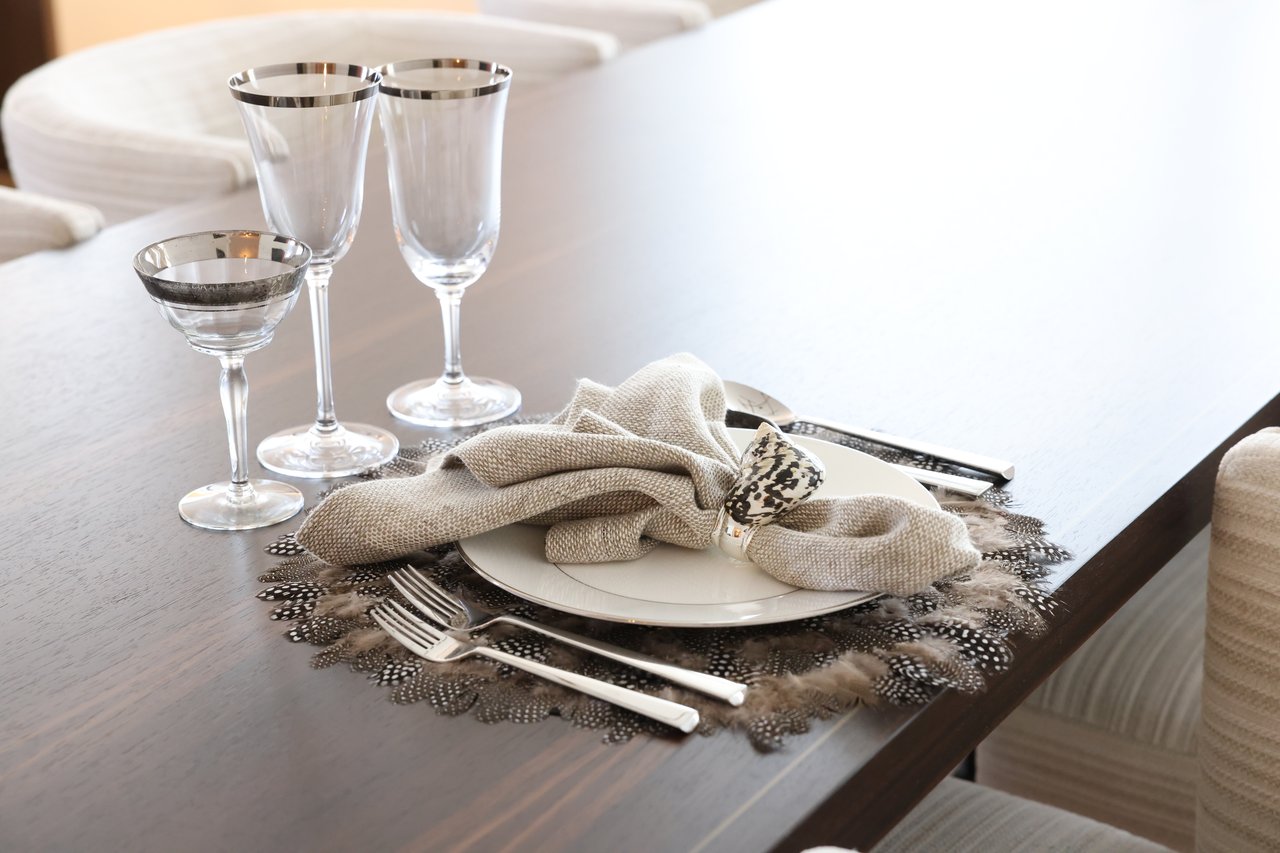
For this table, the oldness lives in the feeling of the champagne glasses — beautiful coupe-shaped glasses that recall another era. They remind me of the 1950s and 1960s, when the world seemed a little more formal, a little more dressed, a little more ceremonial about gathering.
A flute may be practical, but a coupe has glamour. It makes me think of supper clubs, candlelight, conversation, and the kind of evening when people took the time to arrive fully. Maybe it’s a little theatrical, but I love it. A table should have a touch of theater.
The old doesn’t have to make the table feel dated; that’s the trick. It should bring memory, not heaviness. It should give the table depth by adding a little history, a little elegance, a sense that the evening belongs to a longer tradition of people gathering around food, drink, and conversation. In this way, it reminds us that we didn’t invent graciousness, but we interpret it and bring it forward in our own way.
Something New
The newness comes through the dishware and the cutlery.
The China is Jasper Conran for Wedgwood, and I love the way it feels fresh but still connected to a larger design language. It is not trying to be shocking or loud. It has discipline, clarity, and elegance. It belongs to now, but it understands the past.
I don’t want everything to come from the same period, the same mood, or the same store. I like a table that knows how to mix. Something refined next to something natural. Something historical next to something contemporary. This way, the elements feel collected rather than purchased; composed rather than matched.
The new pieces bring the table into the present. They keep it from becoming a costume. They tell the old pieces: you are welcome here, but you are not in charge of the whole evening. The balance matters.
Something Borrowed
The borrowed elements are perhaps my favorite part.
There are pheasant feathers. There are conch shell napkin rings. Both come from nature, and both carry a life beyond the table. The feathers are borrowed from the bird. The shell is borrowed from the sea, from the animal that once lived inside it.
And because they come from nature, they also make the table feel less fixed. Less perfect. More open to movement, conversation, and delight.
A table should never feel sealed off from the world. It should bring the world in. A feather, a shell, a flower, a branch, a piece of fruit in a bowl — these things remind us that beauty begins outside. We borrow it for a while, place it carefully, and let it change the atmosphere of the room. Nature at its finest.
And Never Blue
The phrase usually ends with something blue, but for me, this table is never blue in spirit.
A table shouldn’t feel solemn, stiff, or dutiful. It should feel vivacious. Marvelous. Exciting. Happy. It should bring warmth to the people sitting around it and make the evening feel lifted before the food even arrives. It is not about avoiding the color blue, but about avoiding a mood. I want a table that makes people feel celebrated, not cautious.
Your Own Little World
I often prefer placemats to a tablecloth. A tablecloth can be beautiful, of course. But it covers the whole surface and creates one shared space. With placemats, each person receives a little world of their own, sending tactile messages of hospitality: This is your place. This is your environment. This was arranged for you. Each guest has a setting that feels complete unto itself: the placemat, the dishes, the cutlery, the glass, the napkin ring, the textures and details that make the place feel considered. It is one small environment within the larger environment of the table.
And then, of course, each person brings their own presence to it. This is when the table really begins. The objects may set the tone, but the people create the evening.
Matching the Salad
When Stephen and I give a dinner party, we think about the guest list almost like a salad.
A good salad needs more than lettuce and tomato. It needs cucumber, onion, radish, carrot, maybe hearts of palm, something crisp, something soft, something unexpected. It needs contrast. It needs balance. It needs different flavors working together.
The same is true of a dinner table. You need people who bring different energies, perspectives, stories, and rhythms. If everyone is exactly the same, the evening falls flat. But when the mix is right, the conversation has texture. It moves. It surprises. It becomes something no single person could have created alone.
And the real beauty of a dinner party is the conversation that begins once everyone feels comfortable enough to become themselves.
A Place Made for You
This is what I want people to feel when they sit down at my table.
Not intimidated.
Not impressed in some distant way.
Welcomed.
I want them to feel that their place was considered before they arrived. That the table wasn’t thrown together but arranged with pleasure. That they have been given their own little environment in which to enjoy a wonderful meal and add their own elegance to everyone else at the table.
That is what hospitality means to me — setting the conditions for guests to feel at ease, alive, and included in something beautiful.
The old pieces bring memory. The new pieces bring freshness. The borrowed pieces bring nature. And the mood — if the table is doing its job — is never blue.
It is joyful. It is gracious. It is alive.
Living Happily Ever Always™.