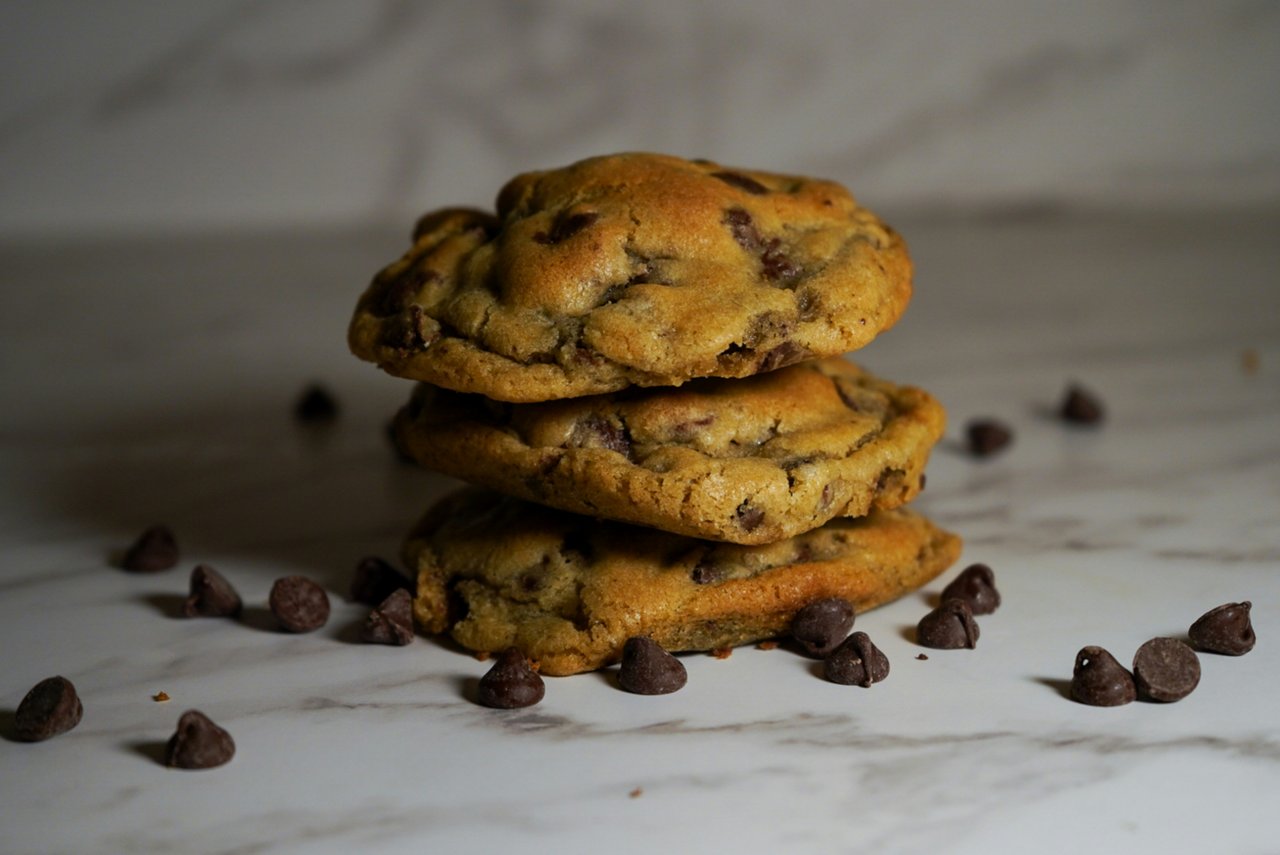
I’ve been thinking about a question that sounds completely unserious.
How many chocolate chips should be in a cookie?
It came to me the way small questions often do — in passing, almost as a joke. But the longer I sit with it, the more I realize it’s not about cookies at all. It’s about generosity.
A cookie, at its most basic, will hold together without chocolate chips. Flour, butter, sugar, eggs—that’s enough to make something golden and technically correct. It will satisfy hunger. It will meet the standard. No one could accuse it of being incomplete. But no one would call it memorable either.
The chocolate chips are not required for structure. They are a choice. They are the part that turns something functional into something delightful. You can ration them carefully. You can distribute them with restraint so that each bite contains just enough. You can be efficient and controlled and sensible.
Or, you can scatter them with intention. You can let them gather in the corners, melt into unexpected pockets, create a cookie where every bite feels like the best bite. The difference isn’t skill. It’s heart.
I have always been drawn to the extra. Not extravagance for its own sake, but detail. The brass inlay in a dining table that no one strictly needs. The leather piping on a chair that most people won’t consciously register but will somehow feel. The small flourish that turns the ordinary into the extraordinary.
It’s all in the details.
In my work, I learned early that I could do what everyone else was doing — unlock doors, cite square footage, quote price per foot. That’s the dough. That’s the structure. That’s what’s required. But it wasn’t enough for me. So I began adding chips.
I learned everything about the building, not just the unit itself. Everything about the block, not just the address. The history. The changes coming in commerce. The school district. The bakery down the street that makes the kind of chocolate chip cookie where you don’t have to search for the good part.
None of that is strictly necessary to close a transaction. But it is necessary to create connection.
We live in a world that rewards efficiency. Minimum viable effort. Check the box. Move on. In business, there’s a constant pull toward what is sufficient. But sufficiency has never inspired loyalty.
Over the years, I’ve sold the same homes two, three, sometimes four times. Buyers who once worked with someone else come back years later and ask me to resell their property. I don’t think it’s because I remembered the room dimensions. I think it’s because they remembered how it felt. They remembered the abundance of information. The warmth. The context. The sense that they were stepping into something larger than a transaction. Instead, they were stepping into a story that was part of a continuum.
They remembered the chips.
There is something quietly powerful about not holding back. About giving a little more than expected. About ensuring that no bite, no moment, feels empty. Ever!
Because the truth is, people can tell when you’ve rationed yourself. They can feel when you’re conserving energy, holding something in reserve. And they can feel the opposite, too — when you’ve shown up fully, when you’ve scattered yourself generously across the experience with enthusiasm.
So how many chocolate chips should be in a cookie? Enough that no one has to search for the good part. Enough that every bite feels intentional. Enough that the person holding it senses that you made it not just to meet a standard, but to create joy.
That’s not a baking philosophy. It’s a life philosophy.
If you’re going to show up, show up generously. If you’re going to do the work, do it with abundance. If you’re going to bake the cookie, don’t hold back.
Happily. Ever. Always!