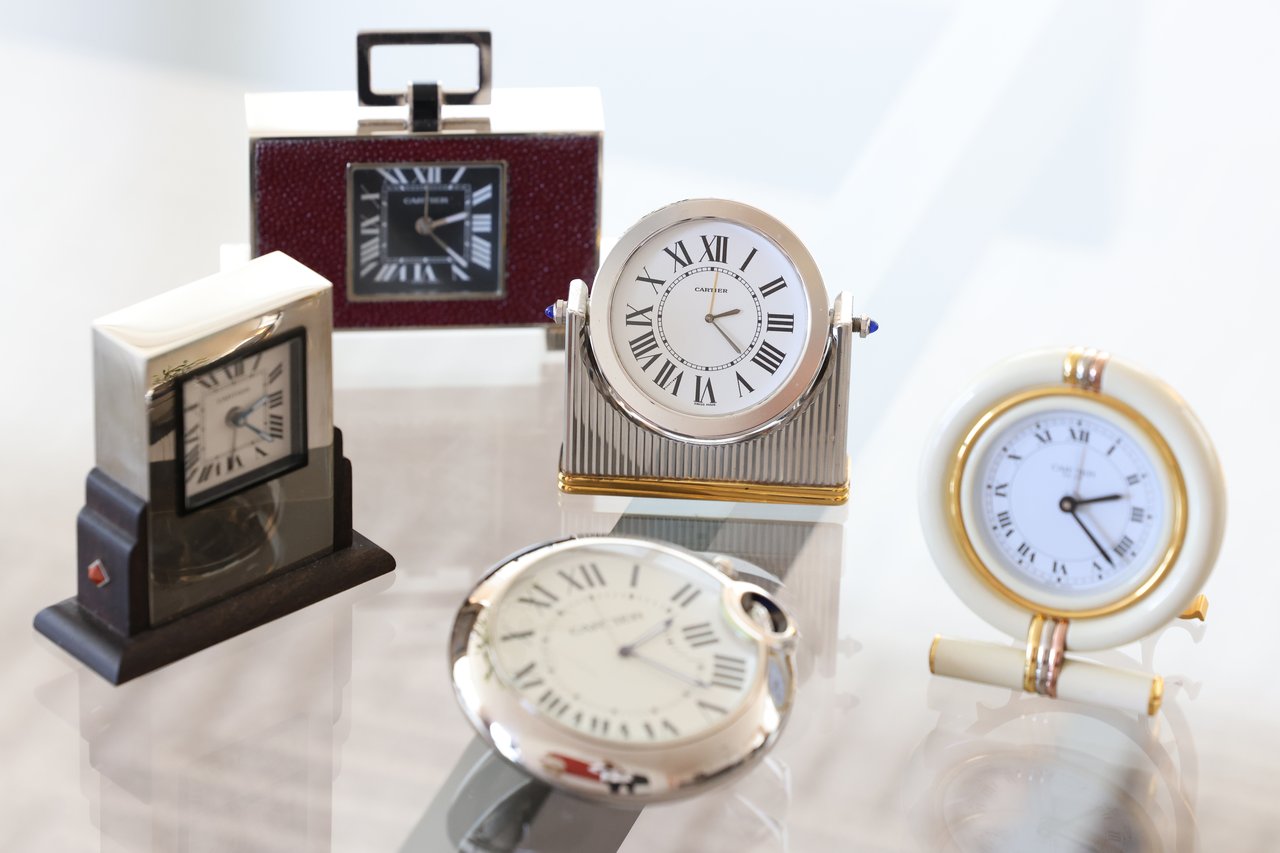
There are five Cartier® clocks in our home. We didn't buy them all at once, and I never set out with a formal plan to build a collection. The first was one I bought for myself. The others came later, chosen with Stephen over the course of our life together — one in Paris, another in Chicago, each discovered at a different moment and loved for a different reason.
The collection now stretches back to around 1990. Thirty-six years is a long time to measure through five objects, and yet that is what these clocks do for me. They tell time, of course, but they also hold it. Each one belongs to a particular chapter, a particular place, and a particular version of who we were when we chose it.
When I look at them together, I see a life moving through time.
More Than the Hour
Time is a fascinating thing. At its most practical, it tells us where we need to be. It organizes the day, keeps appointments from colliding, and lets us know when something begins or ends. It can be useful, reassuring, and necessary.
It can also make us anxious. A clock reminds us of when we are late, how quickly the afternoon has disappeared, and how little control we sometimes have over the hours. We speak of saving time, wasting time, losing time, and finding time, as though it were an object we could place in a drawer and retrieve when needed.
But time is always moving. The hands on a clock advance whether we are paying attention or not. Time passes and events become our history. The future, still mysterious, moves steadily toward us. And as the hours, years, and decades pass, we change along with them.
What once mattered deeply may no longer seem important. What we once overlooked may become precious. A style we once loved may begin to feel like a version of ourselves we have outgrown.
Five Different Moments
Each of the Cartier® clocks reflects the moment in which Stephen and I chose it.
One has beautiful elm wood along the sides of its sterling case, with small red coral details. We bought it at the Cartier® boutique in Paris in the early 2000s. It felt completely current then, yet its design looked backward, borrowing elements from the Art Deco period and bringing them into a new century.
Another is covered in shagreen — stingray — and has a more Bauhaus character. Its geometry is cleaner and more restrained, but it also carries the memory of an earlier design language.
This is one of the things I find so interesting about beauty. New design often gathers pieces from what came before, rearranges them, and offers them back to us in a different form. An old material finds a new silhouette. A historical reference is simplified. A familiar idea is given another context.
The Past, Rearranged
The clocks represent different periods, but they don’t compete with one another. They live together because each one contributes another layer to the story. And in the process, the past reappears. It is borrowed, reconsidered, polished, and placed into a new setting. We change the wallpaper, repaint the room, recover the sofa, and suddenly something familiar feels alive again.
Perhaps this is why certain objects stay with us even as everything around them changes. They are flexible enough to belong to more than one version of our lives. Their meaning deepens because they have seen different rooms, different homes, different days. They become more valuable because they survive time.
The Future Is Still a Mystery
A clock may tell us what time it is, but it cannot tell us what the next hour will bring. We can make plans. We can schedule meetings, organize trips, prepare houses for market, and imagine what the coming year might look like. But the future always retains something we cannot see. If we knew everything in advance, there would be no surprise. No discovery. No sudden call that changes the day. No home we did not expect to love. No object in a window that stops us on the way somewhere else.
Time gives us history behind us and mystery ahead of us. And between them is the present — the only place we can actually live. The Cartier® clocks remind me of that. They mark the passing hours, but they also ask me to notice them. To remember where I have been without trying to return there. To remain curious about what is coming without rushing past what is here.
That’s Happily Ever Always™.