Every December, Stephen brings down the boxes. Not just any boxes, but the ones with decades folded inside them—tissue-wrapped ornaments, faded tags, bits of ribbon saved from years past. Opening them is less like decorating and more like remembering. And the result? A Christmas tree that is decidedly not cohesive—and that’s exactly the point.
Each ornament on our tree carries a story. Some are from travels. Some were gifts. Some were made by small hands a long time ago. They don’t match, but they belong together. And together, they tell the story of our family: where we’ve been, who we’ve loved, what we’ve cherished. This is not a tree styled to impress. It’s a tree meant to comfort, to conjure, to connect. A Happily Ever Always™ tree.
The Choice to Go Artificial
Let me be clear: our tree is not real. And it hasn’t been for years. It never sat right with me—the idea of cutting down a precious living tree, only to dress it up for a few fleeting weeks before discarding it like yesterday’s news. I wanted a tree that could hold all the weight—literally and metaphorically—of our ornaments. One with limbs sturdy enough for the heavy ones, the odd-shaped ones, the delicate ones from long ago.
We chose our artificial tree intentionally—one that feels full and present, but not too symmetrical. It sets the stage without stealing the spotlight, so the magic can come from what we place on it, not the tree itself.
The Ornaments That Speak
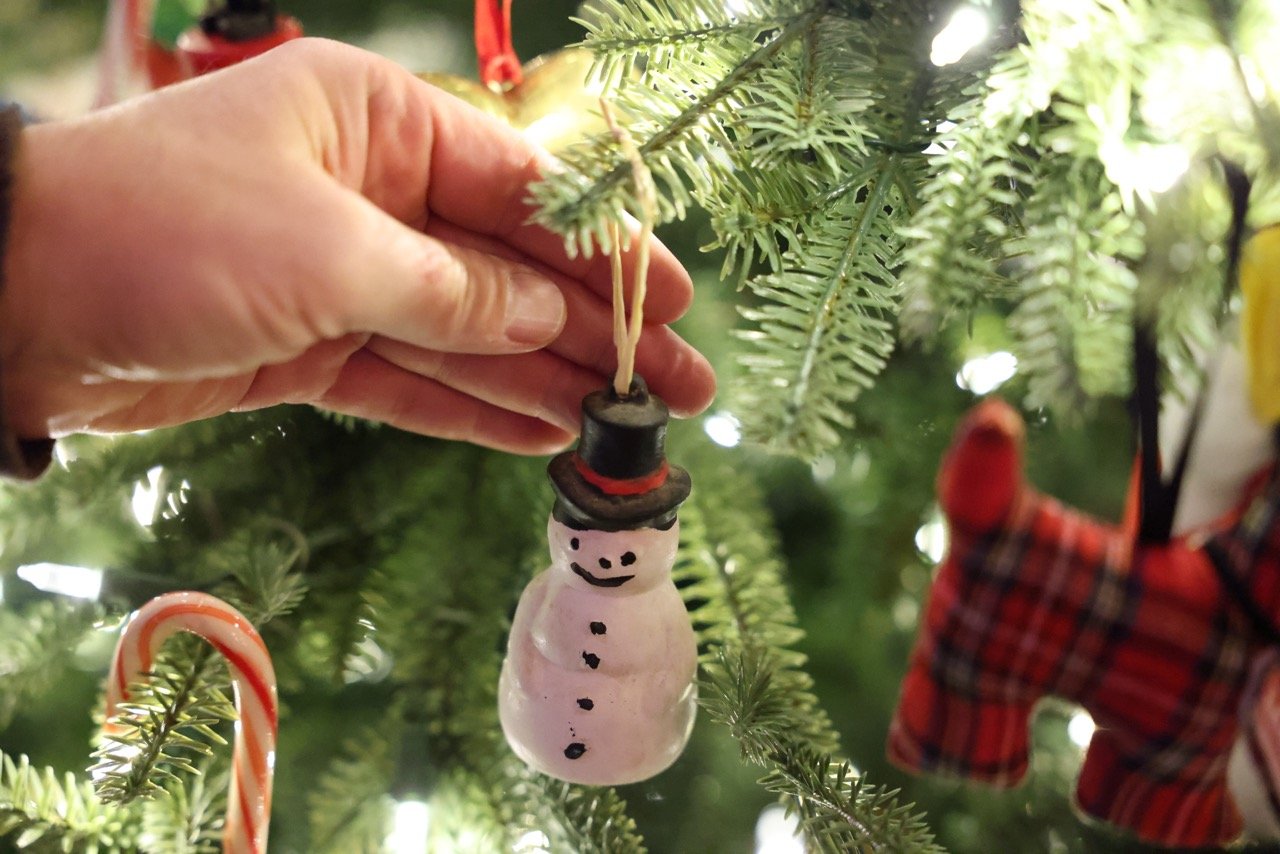
There’s a little white snowman that Stephen painted when he was five years old. A burlap angel with the most peaceful face that sat on Stephen’s family tree steeped in family history as it once traveled from relatives in Germany to his childhood home in Rhode Island. An endless collection of unique and unusual story-telling ornaments gifted by friends. From around the world. There’s even the reindeer that once stood in the glass bauble, now slightly broken but too meaningful to ever retire.
Every ornament finds its place—somewhere near where it always has rested. It’s a choreography of memory, not design. The tree becomes a kind of map. Not of where we’re going, but where we’ve been. And I find that deeply grounding, especially in a season that can so easily tip into excess. This tree reminds me that we already have everything we need to feel at home.
Why the Poinsettias Matter
And then, there are the poinsettias. Not the typical potted plants you see everywhere—but two dramatic, velvet-leaved trees. Years ago, while traveling in Bhutan during the holidays, I saw poinsettias trees, growing in the wild. I was mesmerized. It reframed the way I thought about them—not as filler décor, but as a statement of seasonality, fascination and presence.
So now, I buy them from the same florist every year. I order well in advance. I fluff their leaves, trim the browned tips, and place them on either side of a beloved David Shaprio painting, in our living room. They’re living color in a season of gray. They remind me that even as the trees outside sleep, there’s still beauty to be found in bloom.
I find the traditional plant becomes a rebirth in its variation. And that timeless elegance holds its meaning to us with warm memory.
An Invitation, Not a Display
To me, our holiday home is an invitation. A way of saying: come in. Sit down. You’re safe here. You’re seen here. And so, while our tree may not be “on trend,” it is deeply, unmistakably us. And that’s the kind of beauty I care about most. The kind that reflects something true, and that lasts because its stories are treasured with love.
What This All Reminds Me
Holidays have a way of amplifying everything—our joys, our memories, our longings. But they’re also a chance to root ourselves in what really matters: connection, care, continuity. And sometimes, that begins with the simple act of hanging a well-worn ornament on a not-quite-perfect branch.
Because in a world that asks us to match, to curate, to present—there’s something gloriously radical about a Christmas tree that just is. A tree that holds space for every version of who we’ve been. A tree that, like us, is still growing, even when it returns to its box to await another season. A tree that says: this is what Happily Ever Always™ looks like.