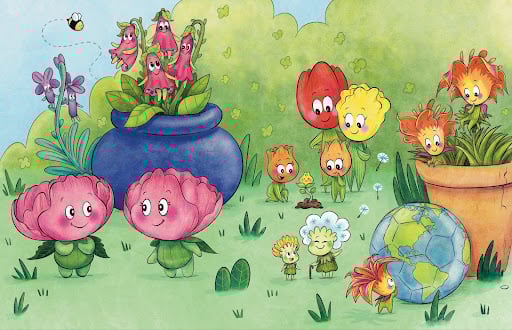
When I wrote A Garden of Flowers, I wanted to offer something tender and true—for the child reading it, for the adult reading to that child, and for the part of all of us still learning how to feel at home in the world.
As I began to write the story, I already knew the butterfly would return. After all, Faith—the wise, luminous and angelic butterfly who helped Fear find his wings in The Caterpillar and the Butterfly—wasn’t done teaching us. But this time, the story didn’t begin with a single caterpillar’s transformation. It bloomed into something bigger: a garden filled with difference, wonder, and community. Faith returns to remind us that transformation is possible, and to gently suggest that it’s not enough to become. We must also belong.
This book begins with a simple, powerful image: a garden where every flower is different. Different colors, different shapes, different ways of blooming. And yet, they all grow in the same soil, under the same sun. That garden, to me, is a metaphor for the world I hope we can create—one where uniqueness is not just accepted but celebrated.
The idea came to me after reflecting on how we live, how we raise our children, and how easily fear and bias can creep in when we don’t understand each other. I wanted to write a story that was gentle, but not simplistic. One that encouraged children—and the adults reading with them—to embrace diversity, inclusion, and the beauty of difference.
And so Faith returns as a guide, a voice of wisdom who helps the flowers recognize their own gifts and see the light in one another. It’s not about being the same. It’s about being part of something beautiful together.
That’s the heart of this story.
The Power of What We See
When I worked with my illustrator, I was very intentional about the images. A red tulip and a yellow tulip bring forth an orange tulip—an image that speaks quietly but clearly to families of all kinds: biracial, same-sex, adoptive. On another page, you’ll see flowers who’ve journeyed from other gardens, planting themselves in new soil. These aren’t just illustrations—they’re metaphors for belonging, migration, identity, and chosen family.
And yet, nothing is heavy-handed. Children don’t need everything explained. They feel the truth of things. The adults reading alongside them? They’ll recognize it, too.
Loving the Gift, You Were Born to Be
At one point in the book, the flowers are told: “Love the gift you were born to be.” That line came to me before I ever wrote the rest. It felt like the reason for the whole book.
It’s a message that lives at the center of my own journey. I’ve spent a lifetime discovering that what once made me feel different—or even excluded — was, in fact, my gift. I want children to feel that early, to hear it in a story and carry it with them as truth.
Quiet Lessons
A Garden of Flowers, like the book before it, holds three quiet lessons—truths I hope young readers, and their grown-ups, will carry with them:
1. Everyone has value. Whether you're the tallest sunflower or the tiniest violet, your presence matters.
2. Understanding begins with listening. It's in our curiosity and care that we come to appreciate each other.
3. Peace starts with kindness. Always, always lead with kindness. It’s the most powerful form of strength I know.
We’re not born to hate. Like the flowers, we’re born to love. But that message flows from the parent to the child. It’s in the tone of our voices, the stories we share, the way we respond to difference—with wonder, not fear.
What I Hope You Hear
Yes, this is a children’s book. But it’s also a kind of love letter to the people who are still learning to love themselves. To anyone who’s ever felt like they bloomed differently. To every parent who wants their child to grow up feeling seen, supported, and celebrated.
If I wasn’t born exactly as I am, I wouldn’t be who I am today. That’s a truth I’ve come to hold with pride. And it’s what I hope A Garden of Flowers whispers to every reader: You are not just enough. You are a gift.
What’s Next?
Faith will be back. And soon, joined by a turtle and a snail. I don’t want to say too much just yet—but let’s just say, they’re on a journey of their own. One step, one bloom, one page at a time.
Until then, thank you for reading. For listening. And for helping the next generation bloom beautifully into whoever they’re meant to be.